I spent the summer at Phoebe, where we build AI agents for home-care businesses. One of my goals was to make our top of funnel meaningfully autonomous. this is some writing on how i tried to do this!
the two most important things I learned
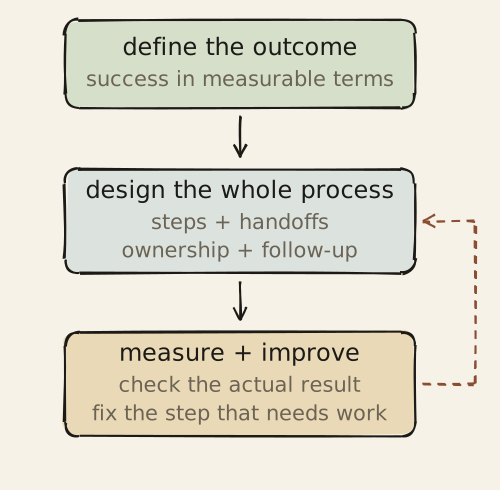
design systems to own the outcome
I was trying to work backward from an outcome while still figuring out what the system needed to do
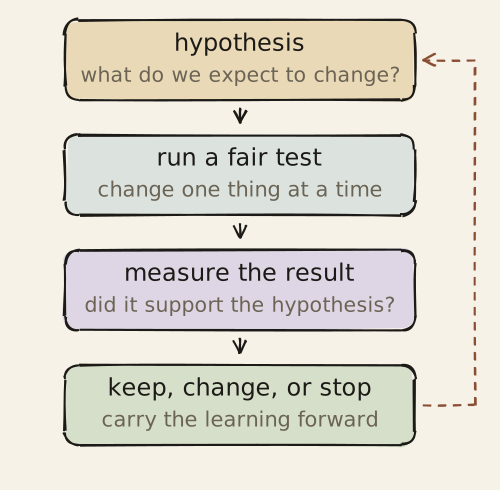
run every idea as a scientific experiment
I wanted to understand what we were actually testing. what was the hypothesis, why might it work, and what would good or bad look like?
our top of funnel
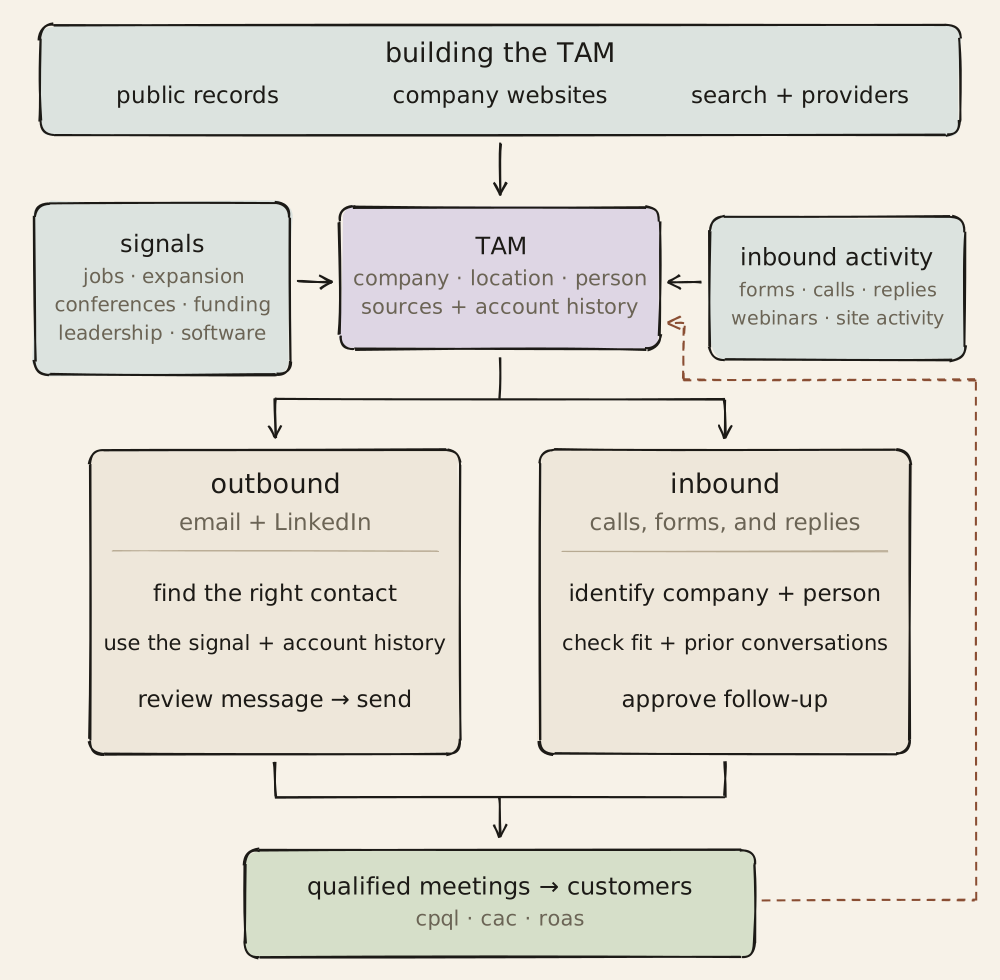
I started with the TAM, our total addressable market. We combined public records, company websites, and providers including Serper, Blitz, Clay, and Deepline to build records of companies, their locations, and the people working there
Then I connected that information to the rest of our outreach. New signals gave us a reason to contact someone. Calls, forms, and replies gave us more context. The system needed to carry that context through the conversation, with deterministic checks and human decisions where they mattered
some terms that were outcome metrics
| metric | meaning | what I used it to understand |
|---|---|---|
| CPQL | cost per qualified lead | Which sources brought relevant demand? |
| qualified meetings | booked meetings with qualified prospects | Did that demand become conversations? |
| CAC | customer acquisition cost | What did it cost to acquire a customer? |
| ROAS | return on ad spend | How much attributed revenue did the ad spend produce? |
TAM agent
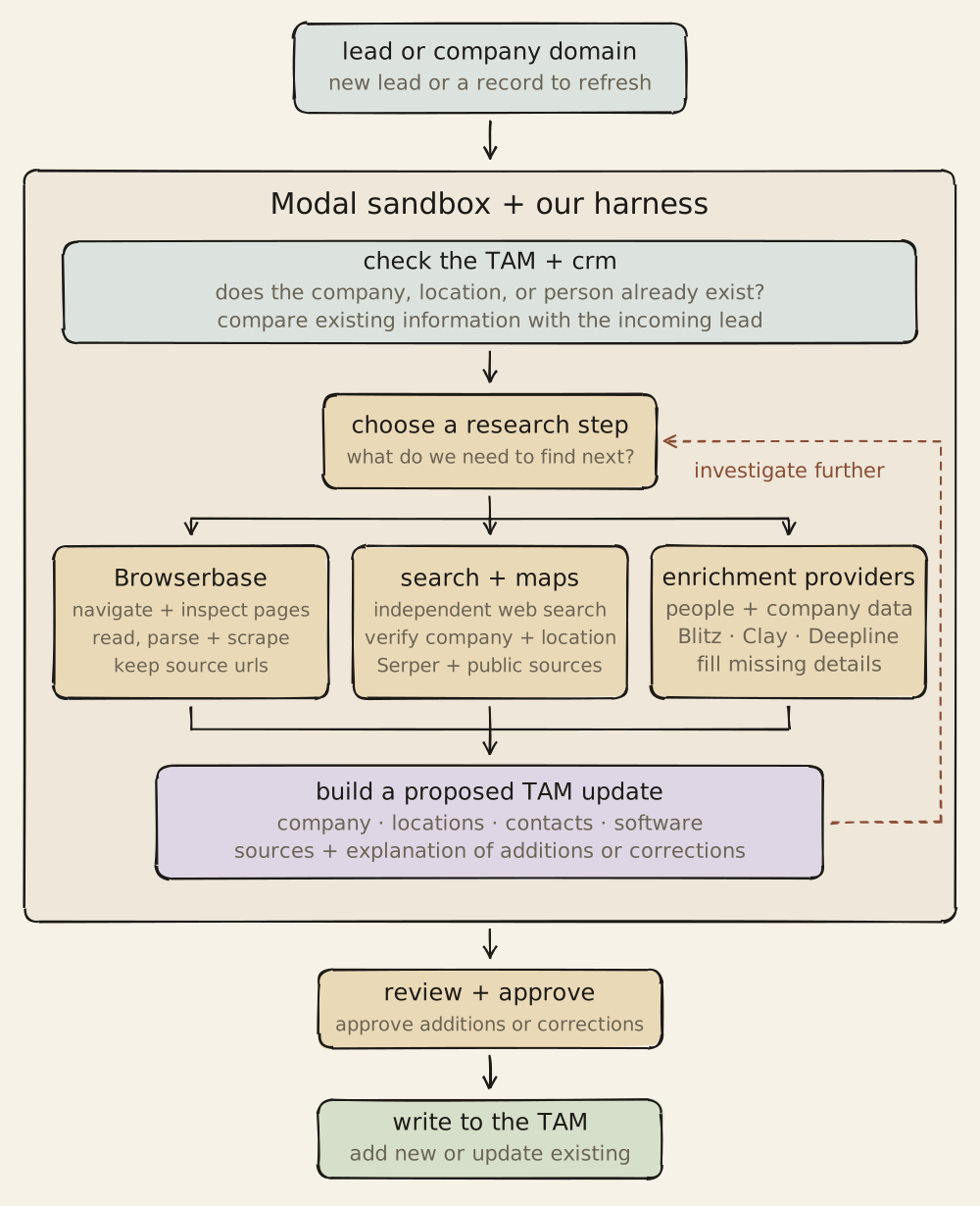
A new lead rarely arrived with everything we needed. I built the TAM agent to take a lead or company domain and do the investigation: check whether the company or person already existed in our TAM and CRM, work out what was missing, and research it
The agent ran in Modal sandboxes with our harness and could use multiple tools. Browserbase let it navigate websites like a person would - opening pages, following links, reading and parsing what it found. It combined that with independent searches and enrichment providers to collect company details, locations, contacts, and software information
Those findings became proposed additions or updates, with their sources attached. After review and approval, they went into the TAM. The same process could revisit existing records as new information came in, so the TAM kept changing with the businesses in it
Google Ads agent
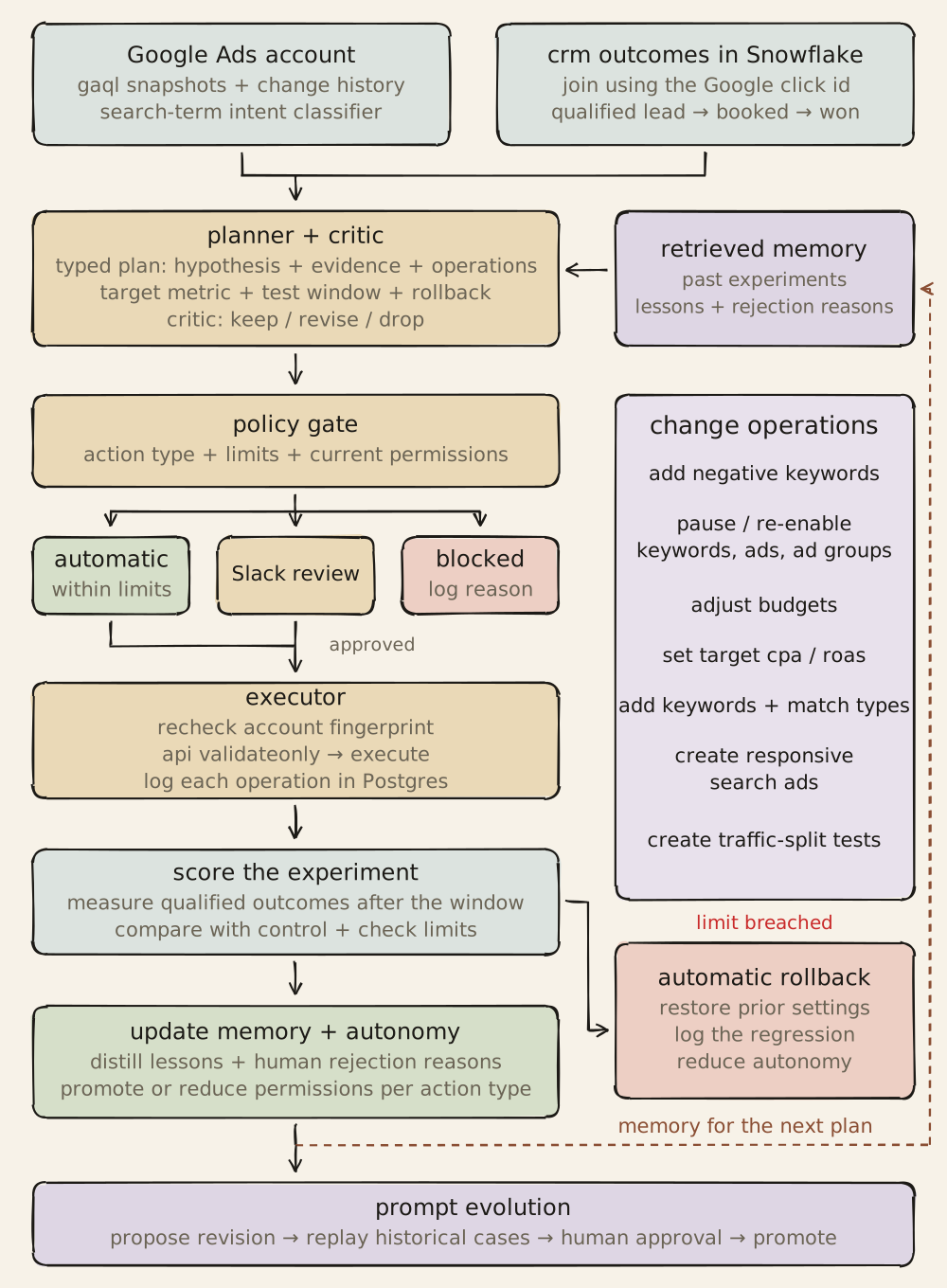
I brought the same approach to Google Ads. We shipped a self-evolving agent that monitored the account, made changes, measured the results, and learned from them. Google Ads data was joined to CRM outcomes through the click ID, so qualified leads and customers could guide its decisions
It could add negative keywords, pause or re-enable keywords and ads, adjust budgets and bid targets, add keywords, create responsive search ads, and run experiments. A planner produced a typed change plan, a critic challenged it, and the executor applied permitted or approved changes after checking the account state
The learning happened after execution. Results and human rejection reasons became memory for the next plan. Individual action types earned more autonomy through their track record, and lost it after a regression. The agent could propose updates to its own prompts, with replay tests and review before promotion. It also rolled changes back when performance crossed the configured limits
Google Ads tools and change operations
The agent used these read tools to investigate the account. Write operations went into a typed plan for the executor
| read tool | what it retrieved |
|---|---|
get_account_snapshot |
campaigns, ad groups, budgets, bidding, spend, and conversions |
run_gaql |
read-only Google Ads queries |
get_search_terms |
searches, their cost, and qualified outcomes |
get_funnel_by |
clicks through to qualified leads, booked meetings, and customers |
get_change_history |
agent changes and human edits |
get_experiments |
open experiments and scored results |
search_memory |
lessons, rejection reasons, and account facts |
get_policy |
current limits and autonomy levels |
| change operation | what it could do |
|---|---|
add_negative_keywords |
exclude terms at campaign or shared-list scope |
pause_entity |
pause a keyword, ad, or ad group |
enable_entity |
re-enable an entity, including for rollback |
adjust_budget |
change a campaign budget within policy limits |
adjust_bid_target |
change target CPA or ROAS with approval |
add_keywords |
add keywords and match types |
create_rsa |
create a responsive search ad with approval |
create_experiment |
create a campaign experiment with a traffic split and duration |
why we changed harnesses
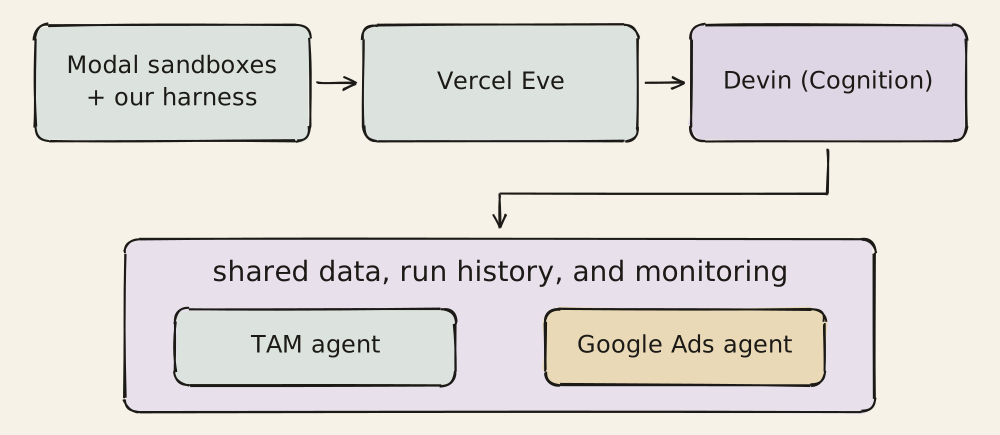
We started with Modal sandboxes + our harness, moved to Vercel Eve, and then to Devin (Cognition). Our team quadrupled during my time there. We needed a shared place where everyone could access the same data, see what the agents had done, and monitor both agents together
Hypotheses I tested
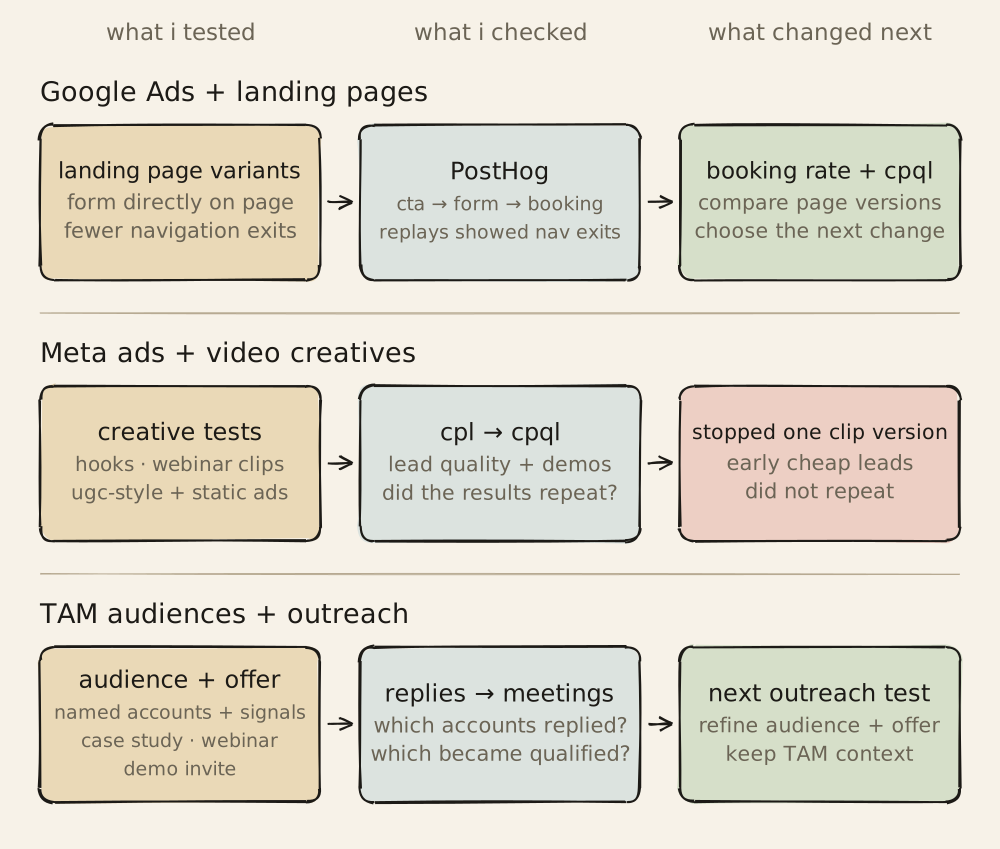
I wanted to see if the landing page was making it harder for people to book. PostHog showed visitors leaving through the navigation, so we tried fewer links and a form on the page itself. We tracked form completion, booked demos and CPQL to see if it helped
On Meta, we tried different video hooks, webinar clips, UGC-style videos and static ads. One clip got us cheap leads early on, but we couldn't get that result to hold up. We stopped that version. I was trying to understand what we could actually repeat
For the TAM, we compared what Blitz and Clay found and checked the agent's results against company websites. Some of the "phone numbers" were tracking IDs, so we had to fix how we pulled them out. I was also trying to work out who would respond and to what - a case study, a webinar or a demo
final thoughts
I think the biggest thing I took from this summer was that my job didn't end when something shipped. I still had to see whether it helped us get customers, and figure out what to test next when it didn't. I want to keep getting better at both - building the system and staying responsible for the outcome